Exclusive interview: Singapore's cyber security czar
Private sector needs to step up to help government in cyber security, says Singapore’s cyber security chief David Koh.
 “While we do all these, the weakest link remains the human factor. The government also has in place employee awareness initiatives to ensure that public officers are kept abreast of cyber threats and the cybersecurity measures to take.”
Elaborating on the human factor being the weakest link, Koh observes that this explains why phishing has been such a popular and successful tool for hackers as users continue to click on random links and attachments.
“Findings from our surveys have shown that while the public are generally aware of cybersecurity threats, they do not take the necessary precautions. This could be due to complacency stemming from Singapore’s reputation as a safe country. Education is the key.”
He adds that CSA, together with its partners, have been working to raise cybersecurity awareness and adoption of cybersecurity measures by individuals and businesses. “This is done through campaigns and events such as conferences as well as the dissemination of timely alerts and advisories through CSA’s SingCERT.
“Our attackers are well-resourced and highly skilled; we cannot win if we don’t level up,” he adds.
Building up skills
The government is committed to ensuring that Singapore has an adequate and well-trained cybersecurity workforce to meet industry demand. “We have launched wide-ranging schemes such as the Skills Framework for ICT, Cybersecurity Professional Scheme of Service, the Cyber Security Associates and Technologists (CSAT) Programme, MinDef’s Cyber NSF Scheme, as well as established the CSA Academy to boost cybersecurity expertise.
“These programmes are designed to raise awareness, and target different segments of the population to join the cyber security industry.”
[blockquote]“Our attackers are well-resourced and highly skilled; we cannot win if we don’t level up.” [/blockquote]
Koh adds that there has been a healthy take-up rate for these new initiatives. “We are also seeing encouraging increases in intakes for our degree and diploma courses. The results will not be immediate but we are encouraged by the responses so far.”
The CSA boss makes a final point that the cybersecurity sector is not all doom and gloom. Cyber security is a source of good jobs for our people, and cyber is a growth industry which offers many opportunities, say Koh.
Global spending on cybersecurity products and solutions is forecasted to exceed US$ 1 Trillion by 2021. At a local level, PwC estimates that the projected market for cybersecurity could exceed US $678 million by 2020.
There is demand to fill up to 3,400 full-time jobs in the cybersecurity profession to support our projected growth, Koh notes, adding: “Against these favourable market trends, our Smart Nation ambitions will be another key demand driver to create economic opportunities and good jobs for our people.”
While Koh captains the team, Singapore certainly needs a strong defence, good training, and reliable partners to clinch the goals.
Amit Roy Choudhury is a senior technology journalist who writes a weekly piece for GovInsider.
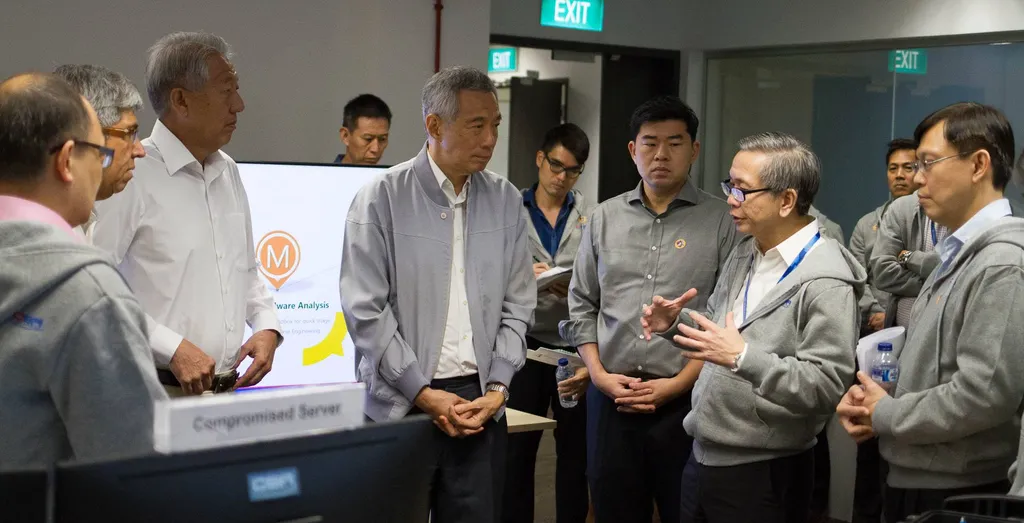
Main image by Cyber Security Agency of Singapore, Facebook
“While we do all these, the weakest link remains the human factor. The government also has in place employee awareness initiatives to ensure that public officers are kept abreast of cyber threats and the cybersecurity measures to take.”
Elaborating on the human factor being the weakest link, Koh observes that this explains why phishing has been such a popular and successful tool for hackers as users continue to click on random links and attachments.
“Findings from our surveys have shown that while the public are generally aware of cybersecurity threats, they do not take the necessary precautions. This could be due to complacency stemming from Singapore’s reputation as a safe country. Education is the key.”
He adds that CSA, together with its partners, have been working to raise cybersecurity awareness and adoption of cybersecurity measures by individuals and businesses. “This is done through campaigns and events such as conferences as well as the dissemination of timely alerts and advisories through CSA’s SingCERT.
“Our attackers are well-resourced and highly skilled; we cannot win if we don’t level up,” he adds.
Building up skills
The government is committed to ensuring that Singapore has an adequate and well-trained cybersecurity workforce to meet industry demand. “We have launched wide-ranging schemes such as the Skills Framework for ICT, Cybersecurity Professional Scheme of Service, the Cyber Security Associates and Technologists (CSAT) Programme, MinDef’s Cyber NSF Scheme, as well as established the CSA Academy to boost cybersecurity expertise.
“These programmes are designed to raise awareness, and target different segments of the population to join the cyber security industry.”
[blockquote]“Our attackers are well-resourced and highly skilled; we cannot win if we don’t level up.” [/blockquote]
Koh adds that there has been a healthy take-up rate for these new initiatives. “We are also seeing encouraging increases in intakes for our degree and diploma courses. The results will not be immediate but we are encouraged by the responses so far.”
The CSA boss makes a final point that the cybersecurity sector is not all doom and gloom. Cyber security is a source of good jobs for our people, and cyber is a growth industry which offers many opportunities, say Koh.
Global spending on cybersecurity products and solutions is forecasted to exceed US$ 1 Trillion by 2021. At a local level, PwC estimates that the projected market for cybersecurity could exceed US $678 million by 2020.
There is demand to fill up to 3,400 full-time jobs in the cybersecurity profession to support our projected growth, Koh notes, adding: “Against these favourable market trends, our Smart Nation ambitions will be another key demand driver to create economic opportunities and good jobs for our people.”
While Koh captains the team, Singapore certainly needs a strong defence, good training, and reliable partners to clinch the goals.
Amit Roy Choudhury is a senior technology journalist who writes a weekly piece for GovInsider.
Main image by Cyber Security Agency of Singapore, Facebook